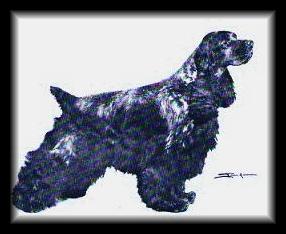
| About Roan Cockers

History of Roan Cockers:
Roan
cockers have always
been a part of the cocker spaniel breed.
At
one time, English cockers and American cockers were the same breed.
Breeders
started breeding smaller and more plush and creating the American cocker
In
the 1800's, small spaniels were developed to hunt woodcock. The sizes of
puppies from these early litters varied widely.
The
first stud book of the Kennel Club (United Kingdom) divided the dogs by
weight alone.
If
a spaniel weighed under 25 lbs, it was called a Cocker Spaniel. If a spaniel
weighed over 25 lbs, it was
called
a Field Spaniel.
Problems
existed with the weight designations, so it was decided that type
should
be considered more important than weight.
The
American Spaniel Club, which was formed in 1881, created Breed Standards
for each Spaniel type.
The
Kennel Club (UK) had separated the different types of spaniels in the Stud
Book by 1893.
In
America, after World War I, the English Cocker type was not as in demand
nor favored as
the
American cocker type which was forming.
The
American type was smaller and more elegant.
The
two Cocker Spaniels were shown together, competing against one another,
until
1936, when the English Cocker received status as a variety.
Pedigree
research began in order to separate the English Cocker from the American
Cocker.
The
English Cocker Spaniel Club of America pledged not to interbreed the two
types.
The
American Kennel Club granted a separate breed designation for the English
Cocker Spaniel in 1946.
. In
1946, Mrs. Geraldine Rockefeller Dodge managed to get the 2 breeds who
by now were distinctly different,
separated
and the American cocker was called the Cocker spaniel and the
English
was called the English cocker.
Because
these 2 dogs came from the same mold, so to say, all of the colors,
patterns
and markings were shared, such as black, brown, buff, parti, (mahogany)
sable,and roan, along with tan points.
Because
many English cocker breeders bred roans, most of the American cocker breeders
elected to stay away mostly from
breeding
roans since they reminded them of the English cocker.
However,
the Philsworth Kennels continued breeding roan cockers
and
your "true" roan cockers from today can be traced back to this kennel
which
can be traced back to the English lines.
Roan
in American cockers has never been a very popular color until the past
few years.
There
are some dedicated kennels who have been regularly breeding roan cockers
for quite a number of years.
Their
roans can be traced to Campbell Kennels who bred from the Fourwinds Kennels,
whose
roans came directly from the Philsworth lines.
Those
of us who breed roans, can be traced into these earlier kennels.
Some
of the Philsworth roan Champions were:
CH
PHILSWORTH'S BLUE BRINE (b.1945)
CH
PHILSWORTH'S BLUE SKYLARK
CH
PHILSWORTH'S BLUEBIRD (b.1940)
CH
PHILSWORTH'S DEEP BLUE
CH
PHILSWORTH'S VICTORY BLUE, CD (b.1944)
Description
of Roan Cockers:
Roans
are considered parti cockers and are shown in the parti classes.
Roaning is a mingling of colored hair mixed into the white hair of a parti.
Much
like W= white hair and B=black hair.
The
roan pattern would look much like WWBWWWBWWB.
Although
some roans may also be ticked, this isn't desirable
when breeding for roan.
Some
people get ticking confused with roaning.
They
are not the same and erroneously register
their cockers as roans when they are not.
Ticking
is like little spots..freckles per se, and the gene for ticking is on a
separate allele than roan.
A roan
is generally bred if possible to a very open marked parti,
The
more white the better.
If
the roan is bred to a closed marked parti,
the
dog often can over roan and will eventually look much like a mismarked
solid color cocker.
The
only roaning that can be seen in a heavily marked roan is generally
on
the chest or possible one or 2 spots on the back on belly.
Roan
is a simple dominate gene.
Which
mean either you have it or you don't.
It
is not recessive and cannot be carried
over generations and produced.
If
a dog is roan, then either one or both of it's parents are roan
You
can trace the roan down in a pedigree all the way back.
In
a roan litter, generally, you can tell the roans from birth as you may
see some smudging of color around the nose or feet.
Some
say you cannot tell at birth until about 2 weeks before the roaning becomes
apparant.
But
from my own experience and experience of some others, this isn't true.
The roan is apparant
even
though possibly in very small quantities, from birth.
Roan
colors in American Cockers are:
Blue
Roan-Which is basicly a black and white parti
where the individual black hairs imtermingles
with
white which often gives a bluish appearance.
Brown
Roan, Chocolate
Roan or Liver
Roan-Brown and white parti with brown hairs
intermingled in the white
Orange
Roan..sometimes called Red
Roan & Strawberry
Roan-Which is a red and white parti with red
hairs intermingled in the white
All
3 can also have tan points, although you generally won't really see the
tan points in a red roan
There
are NO health issues associated with the roan gene.
NOTE!
Roans & Merles are NOT the same thing!
UPDATED:
AKC in the past until just recently,did not allow merle breeders and owners
to register their merle
cockers
as merles and the majority of merle breeders were encouraged by AKC to
register them as roans.
Because
roan was not a well known pattern, people have been getting confused thinking
merle is roan.
It
is NOT!!
They
are 2 completely different patterns.
Merle
carries a lethal gene IF BRED to another merle.
Roan
does not.
This
is very upsetting to the dedicated roan breeders and is also upsetting
to those who breed merles.
If
you don't know if your "roan" is merle or roan, please ask one of us in
the roan cockers facebook group.
Please
try and register your roans as roan and your merles as merle;
or
at least put merle in the registered name of the merle dog
so
others know what color/pattern the dog is.
For
more information on the Merle Cocker Issue,
please
check out our website: Merle Cockers:
Fact or Fiction
If
you are searching for an actual roan cocker, please do your homework;
Ask
the breeder about whether the cocker is
roan
or merle.
Some
breeders do not know the difference and often think their merle cocker
is a roan.
You
will still find several websites and business websites that advertise puppies
who still list merle cockers as roans.
More
education is out there now so most breeders do know the difference
but
there are still those who don't and looking at pedigrees can get confusing
for many.
Although
roan is becoming popular now,
Roans
are still generally fairly rare AND
are NOT being bred by very many breeders.
Quality
roans are being bred by even less.
Roan
breeders are very protective of their roans and have spent a lot of time
and energy attempting
to
preserve the roan in todays American Cocker.
©
Connie BC-C'lestial Cockers 2000-2015
All
Rights Reserved
Please use your
Back Button
to return to
previous page |
|